

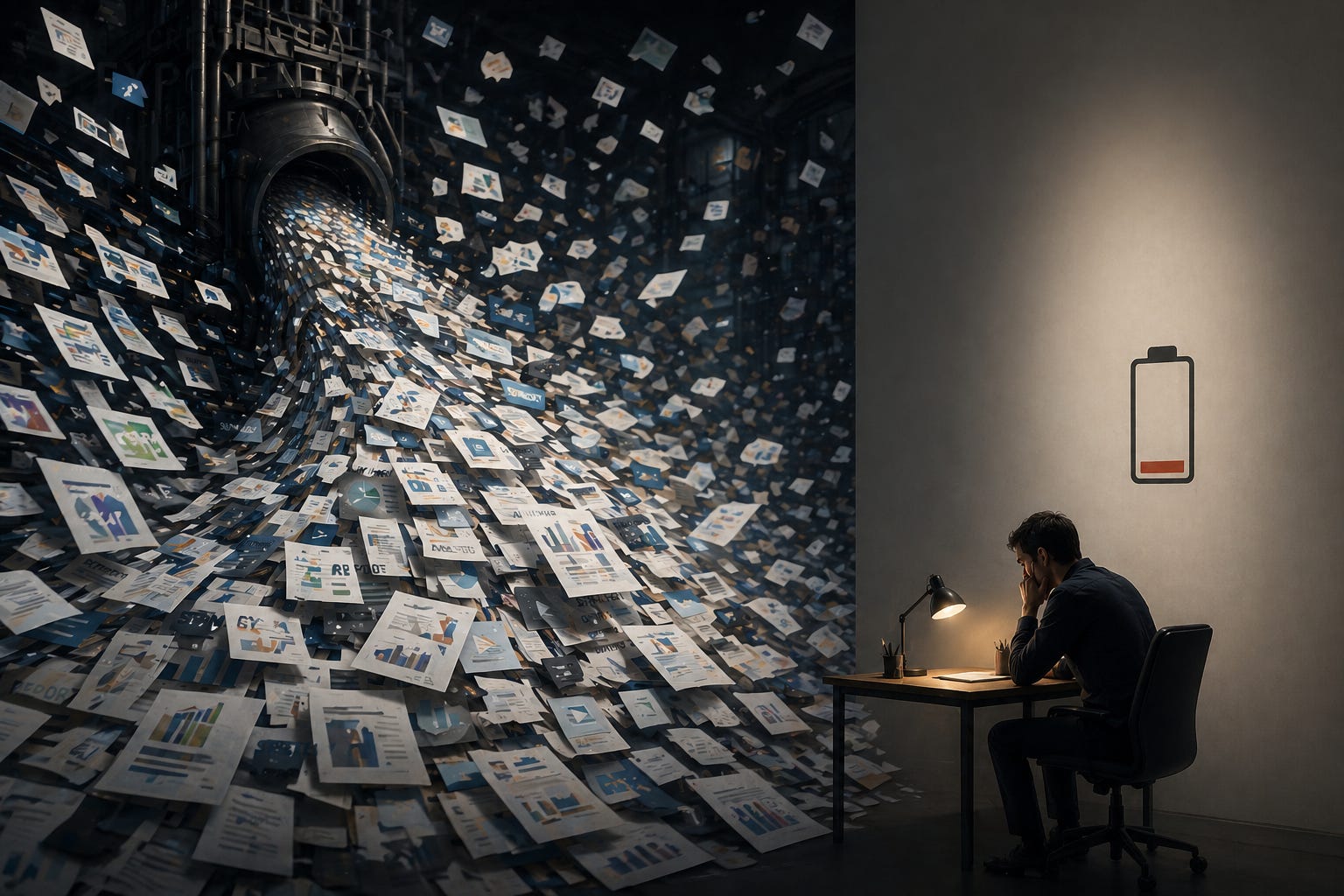
We’ve dramatically scaled our ability to create.
We can now:
Draft reports in seconds
Write a 20-page strategy proposal in minutes
Build a new product in half a day
Outline a full marketing campaign to launch it in a few prompts and clicks
The friction is mostly gone.
And with it, something else disappeared too: a natural filter.
Before, writing required real effort. Remember the days of starting any document from a blank, empty sheet?
That effort forced reflection.
And reflection forced clarity.
That natural filter helped us digest before we shared. Which is a good thing for the creator, but also for the recipient of that information.
It’s very different now.
AI has scaled content creation exponentially. But human cognition doesn’t scale.
We, as humans, still:
Read at the same speed
Process with the same attention
Decide with the same mental energy and biases
Prioritize with the same limited focus
So we’ve created a system where:
Our ability to produce information has scaled dramatically - but our ability to absorb and act on it hasn’t.
This creates a new kind of waste.
Not necessarily bad information.
Not wrong either…
I’m not sure what to call it. It’s just… too much?
And when it’s too much - too many documents at the same time, too many drafts, too many features being shipped, too many vibe-coded prototypes - that information turns into noise.
Productive garbage.
I’m calling it productive because there is a certain sense of productivity in all of this. But output doesn’t equal value.
When content becomes cheap, accountability often does too... It’s easy to share an AI-generated draft while distancing yourself from its quality or usefulness:
“It’s just a first draft from Co-pilot!”.
But once that draft is shared, someone else still pays the cost in time, attention, and mental energy.
So the system fills with:
Well-written but generic ideas
Long documents nobody reads
Content without ownership and accountability
Options without thoughtful judgment
What happens then?
What I’m seeing is that critical information now gets diluted.
Valuable features are now at risk of becoming invisible, competing with a hundred options your customers have to juggle.
Campaigns that would truly move the needle in your business now compete for attention with mediocrity.
In other words, signal gets diluted.
Not because all of this stuff lacks quality, but because the environment can become saturated.
So what’s the real problem here?
The problem is not using AI to:
Brainstorm
Challenge
Draft
Explore
Clarify
Iterate
Build
That’s incredibly powerful. I love it, and I’m sure you love it too.
The breaking point is oversharing.
The creator saved time, but the receiver pays the cost.
And this is the asymmetry most people are missing.
In the Age of AI, the bottleneck is clearly no longer creation. It’s attention.
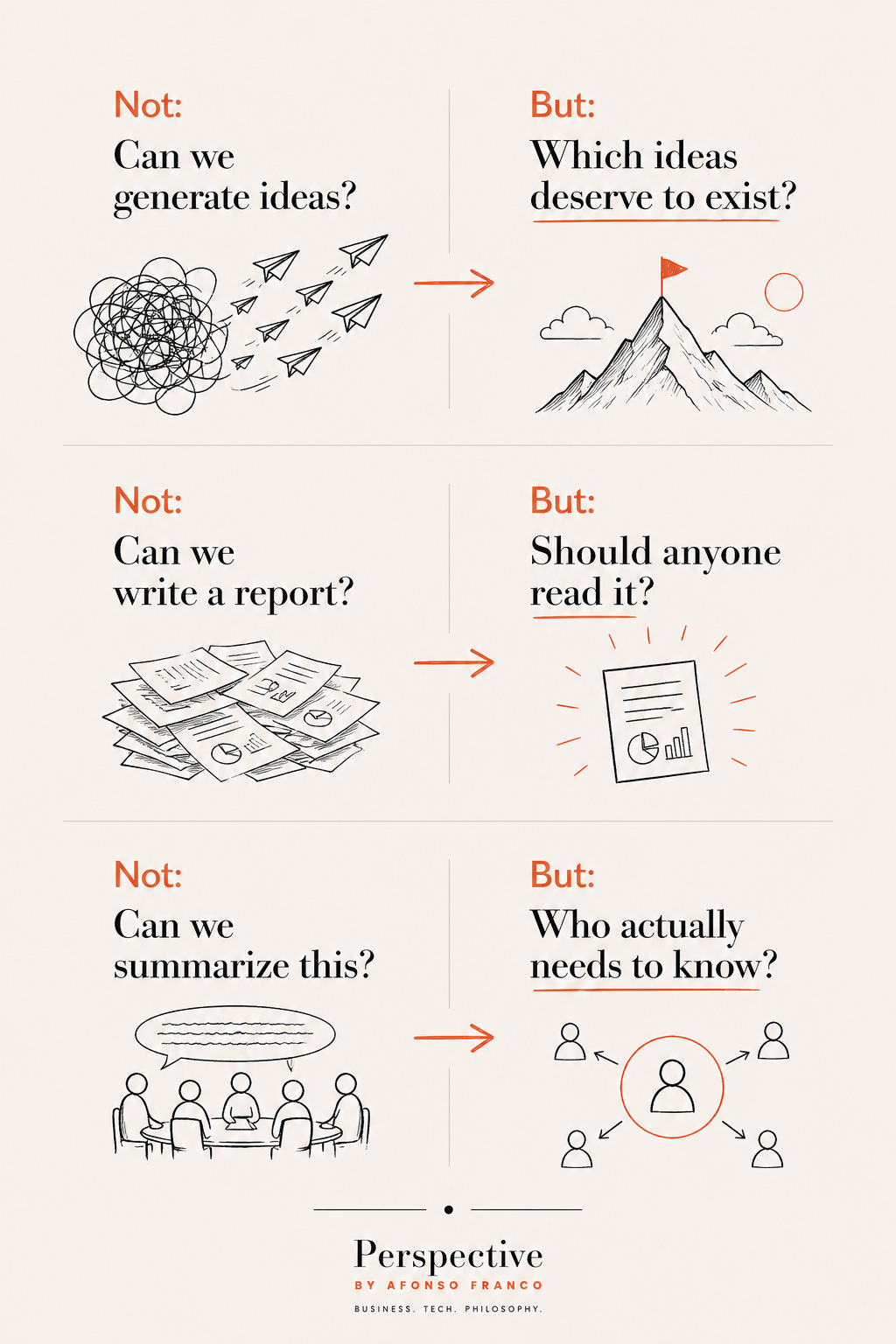
The new responsibility
Using AI responsibly (in this context) doesn’t mean generating less. It means sharing less.
AI should help you expand your thinking. Not expand everyone else’s workload and dilute signal.
Share what’s valuable, when it’s valuable, to someone who’d benefit from consuming it.
In a world where everyone can create, the most valuable people are not those who produce the most.
But those who:
Say less
Say it clearly
Say it at the right time
And remove more than they add
The paradox of AI “productivity”
AI makes us faster at creating. But speed without curation creates noise.
Noise clouds judgment. Poor judgment hurts results.
So ironically:
The more you generate without judgment and curation, the less productive you (and those around you) become.
By now, you’ve learned how to leverage AI for creating more and faster. That’s great.
The next skill is rarer, and perhaps more human: knowing what deserves to exist.
Interesting reflection; as I was reading it, I could not help to think of the change on our behavioral patterns that brought the digital photography. Back then on my childhood, the number of pictures was strongly limited by the size of the reel, so you would think carefully before shooting each Photo; the angle, the light, the pose.. then each picture became a memory you would look at often in your albums; then digital Photography came and we end up with hundred of similar pictures of the same scene, just clicking with no full attention to why we try to capture… and at end, phones full of thousand of picture that most of the times we never check again; quantity over quality;
I think you are totally right about your reflection and is up to us on how we manage this change
The first thing that came to mind was Apple on AI. While they did announce their Apple Intelligence during the initial hype, they've never really launched it. And I think it is because of this. They dont do what everyone does, they want to think different. So they lag behind. Are they hurting because of it? Probably. Would it be worse if they did what everyone else did? For sure.
Thank you for putting words to these reflections.